There were times in the past when I felt tempted to stop strangers on the street to ask them what type of fabric softener they used. They’d walk past me, and their clothing smelled so fresh and clean! I would have loved to know what the scent was so I could go get a bottle of it for myself. That’s until I found out that a lot of people experience gunk and buildup in their washing machines due to fabric softeners, which over time can cause problems such as mold and smell. I have had a smelly machine in the past, and there was nothing I could do to get rid of it; the smell could sometimes go away for a couple of weeks if I used products to eliminate smell, but it would always return. Instead of my laundry room smelling nicely of clean clothing, detergents and softeners, it smelled dirty. And the smell came from the machine, there was no doubt about it. When I got my new machine, there was no smell, and as I found out about the possibility of softeners being a culprit, I decided I wouldn’t chance it. I had to find an alternative method to softening my clothes.
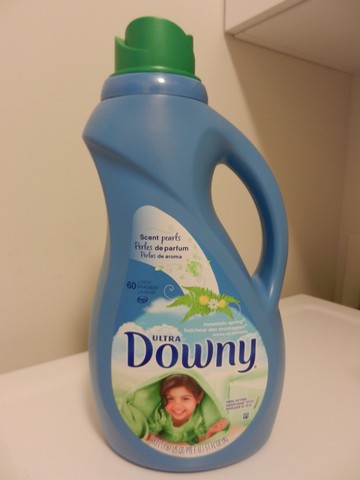
Downy! Oh, how much I loved the scent on my clothing when using Downy laundry softener! Before I knew anything about buildup and smell, I used it regularly, until we had a repair-man over for our old washer. He had nothing but negative words to speak of Downy. He said it is so concentrated that it causes problems in washing machines, so you should at least dilute it before using it. So I did. When I later learned more about the problems it can cause, I decided to stop using it altogether in the washer. After all the problems we’ve had with washers in the past, I’m simply not willing to risk anything. I did find out how it can be used in the dryer, however, without causing problems. But first, some alternatives to using softeners in the machine:
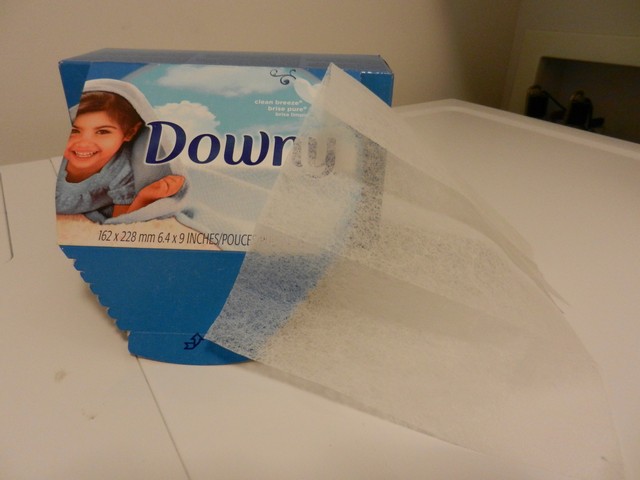
I’ve gone over to dryer sheets, which work well for softening and taking out the static. They don’t leave nearly as much scent as the liquid fabric softeners do, but they work well otherwise.
Something else that works well as a softener and static remover is plain, white vinegar. (Norwegians: vinegar is the same as eddik.) Now that I don’t use liquid softeners anymore, I pour some vinegar into the softener-compartment of my washing machine (though never at the same time as I use bleach / chlorine in the load; see the disclaimer under this paragraph.) I use about 1/4 cup or so per load, in my large front loader, though in the smaller European / Norwegian washers you only need a tablespoon or two. If you use too much, you’ll find that your clothing will smell a bit sour. It smells nice and clean if you don’t overdo it. In addition to softening and removing static, another benefit is that it also sanitizes, so it aids in cleaning your clothes. Finally, it’s not supposed to be irritating to sensitive skin, which can be a huge help for people who are sensitive to the perfumes, dyes or other irritants commonly found in softeners and dryer sheets. Vinegar contains none of these, and is believed to be safe and harmless for most people. (Don’t take my word for it, though; always check with your doctor first.)
So it’s a 3 in one, and it’s CHEAP! I purchased my gallon for $2.74.
DISCLAIMER: Please make sure that you never mix vinegar and bleach; if you are going to add bleach / chlorine to your white wash, no NOT use vinegar in that load, as it will cause a chemical reaction resulting in toxic fumes!
Editing to add that vinegar also helps clean the machine, according to the comment below by one of my readers. Good tip, excellent reminder! Thanks for adding that! It is a well known fact that vinegar cuts grease, and I have personally found it to work very well in general household cleaning. So it makes sense to me that it would also help clean the washer itself. Isn’t that a funny thing, though, that a washer would need washing?
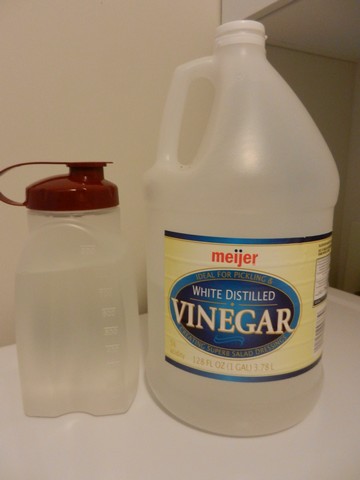
I keep a gallon of vinegar in my laundry room, and pour it into a quart pitcher w/ lid to make it easier to use.
Back to softeners: I did have a bit left in one bottle of Downy Laundry Softener, and wondered what I could do with it. When I started searching, I found that you can make your own dryer sheets with the liquid softeners. So I tried it, and it works well. It’s the same as before, though, regarding scent. It’s not as strong as it used to be. But it’s much cheaper, and quite simple, and it does allow me to continue to use it if I want to:
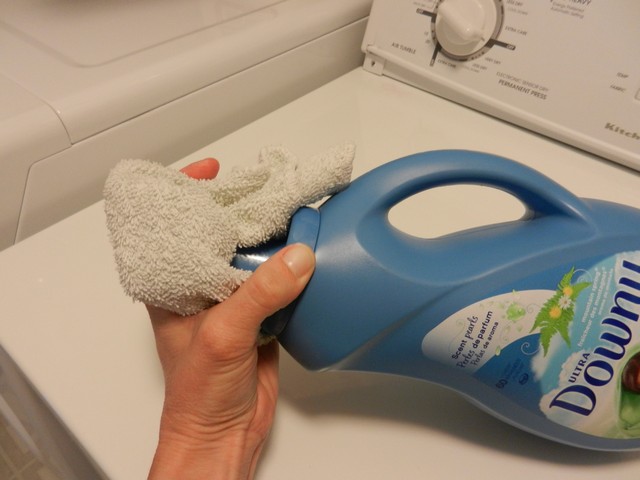
First I took an old, clean rag, and tried pouring the softener into it to drench it. It was a bit tricky and I could tell I would end up making a mess. Of course, trying to take a picture in the process doesn’t exactly make things any easier! Two hands are definitely better than one.
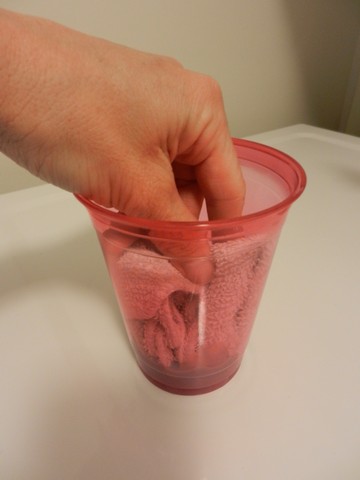
So I poured a bit into a cup, and dunked the rag in there, squeezing it until soaked through.
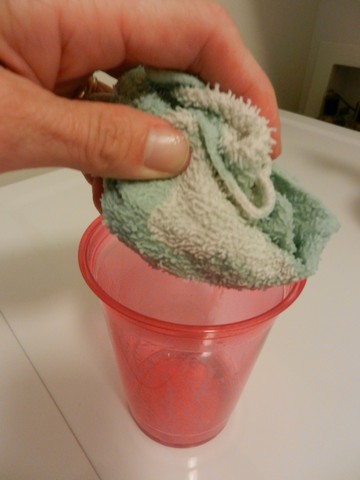
Squeeze, crunch, working it in there.
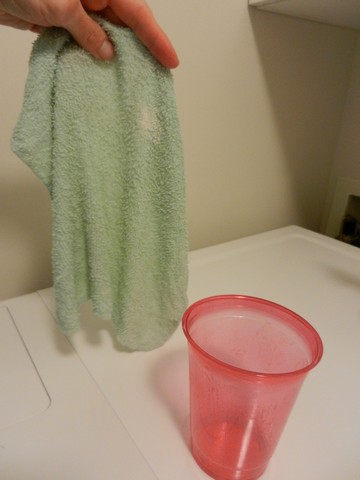
Now moistened, though not dripping wet.
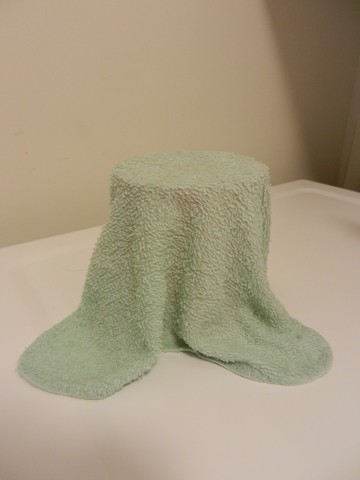
Then I left it to dry. I just hung it over the cup to dry overnight. My laundry room sure smelled nice when I went in there the next morning! Maybe I should keep some rags lying around the house, so people will think all of my house is super clean at all times… Though they’d have to close their eyes to be fully convinced! But, I regress. I have also tried to soak a rag and toss it directly into the drier without drying it first, and this is a mistake to do. I have found that this will easily cause stains on clothing, almost like a grease stain. So I’m back to making sure the rag is fully dry before using it.
This “sheet” can be tossed into the dryer along with your load, just like a regular dryer sheet. It can be used several times until you can see that most of the softener is gone or it no longer does much of anything for your clothes. Then repeat the process. Some people find that they work for a very long time, I think I read 40 loads… Well, I don’t know about that. I suppose it depends on how much of a softening effect you need, and how much scent you want on your clothing. It is easy enough to try it and find out what your own preferences are. I reuse mine maybe 5-6 times or so, then resoak.
So this is what I currently do: Wash with regular, liquid laundry detergent, then use vinegar in place of laundry softener in my washer. Tossing my load into the dryer, I also throw a dryer sheet in there, or a dried rag of soaked up laundry softener to give the load some of that nice scent that I love so much.
One last thing I want to touch on, is liquid versus powdered detergents. After one of my readers commented (which you can see in the comments section below) that liquid detergents can also cause build-up, I decided to read up on that subject. I still have to study it more in order to be able to make conclusions, but from what I have gathered so far, there seems to be a correlation between liquid detergents and buildup. What I have found so far, is that liquid detergents contain some kind of animal fat; it only makes sense then, that this could cause build-up. However, powdered detergents are not necessarily innocent either. It really depends on what water temperature you use: If you use cold water, powder cannot dissolve all the way, and the undissolved powder can also clog up your machine. However, if you up the temperature to at least 86 degrees F, or 30 C, it dissolves as it should, and many say it actually will work better than the liquid detergent. Another problem with liquid detergent, is that in front loaders, it will start to flow into the machine as soon as you put it in the dispenser, before the water starts to pour into it. I’ve read that this can cause clothing to stain, since concentrated detergent gets directly on the clothing and may not properly mix into the water, although I’ve used front loaders with liquid detergent for many years and it’s never happened to my clothing as far as I know.
HE powders may be tricky to find, but according to my one reader, it can be found at Costco, of Kirkland brand.
Love this blog about fabric softener. I just recently read that using liquid fabric softner in a front loading washer will cause build up . . . so, I’ve been wondering what to use as an alternative. Vinegar is a great option to help clean the clothes, as well as keeping the washer clean. Did you know you’re also not supposed to use liquid detergent in a front-loader b/c of the risk of build-up. I switched over to Costco’s powder detergent awhile ago for this reason. Thanks for the info!
Thanks for commenting! You’re the first one, congrats!! 🙂
I did not know about the liquid detergents. Thanks for letting me know! Will have to look into that.
And good point about the vinegar also cleaning the machine! Will add that to my post.
Hi, Terese, my name is Annabelle.
By the way, I have an aunt named Terese. I use Downy in my washing machine, but unfortunately my mom says it gives me a rash. I’m wondering, what is a natural alternative for me to make my knitted afghans have a nice scent, as well as having no static? I’d like to try something natural, but I don’t want them smelling like a salad! What I invision is something like the scent of a soft ocean breeze, the calm scent of lavender, or even the scent of eucalyptus would be nice for me. The only thing I can think of is essential oil, but I don’t know how that would do in the washing machine. Also, since I’m blind, what would be the easiest way to measure it into the machine without making a mess? If you have any further information, questions, or suggestions for me, please feel free to Email me at any time, as I check my emails several times each day.
Kind Regards,
Annabelle
Hi Annabelle,
I’m not sure what might be a good option for you; vinegar in the rinse cycle works well for keeping down static and is usually well tolerated. If you have found essential oils that you like for scent, you may want to test it first, diluted, to find out if your skin tolerates it. Never apply it full strength, as it will be way too strong!! Essential oils are extremely potent, so it takes very small amounts. The following website ( http://www.naturesgift.com/methods.htm ) suggests to dilute it to 15 drops per ounce of carrier oil. Try it at your own risk of course. If you know that it will be fine for your skin, then I suppose the next step is to figure out how to get it on your afghans, if you think they will tolerate it. This same website, if you scroll down a bit, has some suggestions as to how to use essential oils in washers, but they also say that some e. oils can do damage to plastic plumbing. So you may have to look further into it for the specific oils you are wanting to try. They also suggest you could add a few drops of it to a cotton cloth and toss it in the dryer. I don’t know if your afghans tolerate dryers, so you’ll be a better judge of that than me. It depends much on what materials they are made of, of course.
I hope you figure out how to make it work for you!
My afghans are made of yarn, with satin skeins around the sides. When I put them in the dryer, I put them on the Delicate Cycle. In the Washer, I put them on the Delicate cycle in cold water.
OK, well, I hope it works out for you and that you’ll get a result you love. If you find a way that works well, I would love to hear an update. Thanks so much for commenting and for your interest!
If you could give me a bit of advice, what would your best solution be?
Since I don’t have experience with the materials your afghans are made of in combination with essential oil, I am unable to give more specific advice than this. I don’t want to risk giving you advice that could potentially cause damage. If you still want to explore the idea of using essential oil in the washer or dryer, there is some information available on the internet, such as this site: http://www.selfgrowth.com/articles/using_aromatherapy_essential_oils_in_the_laundry This blogger does also warn that oils in the washer could cause damage to plastic plumbing, so please keep that in mind.
I’m trying out Seventh Generation Lavender and Blue Eucalyptus dryer sheets. The up side is, they don’t coat the lint filter with that chemical substance as found in things like Bounce and Downy, so when I empty it, the lint filter comes out clean! Another upside is, these dryer sheets are 100% recyclable! That means I no longer have to throw them in the garbage can, they can just go into my recycle bucket. The downside, however, is that the dryer sheets don’t give off much of a scent, so my clean stuff smells mostly like paper. Another downside, they’re $5 a box! And it only comes with 65 sheets. And, I can only find them at a place like Market Of Choice, which sells a lot of natural and organic stuff. I want to try the liquid version of the Seventh Generation Fabric Softener, as I found out it won’t give me a rash because it’s all natural, but the downside with that one? It’s $9 a bottle! What do I do next?
Thanks for sharing! Wow, those products sure are expensive! But at least you’re not getting a rash from them. That’s good.
Hello from Rhonda –
You can make your own laundry soap with Borax , bar soap and Washing Powder. To that you can add essential oils or soap fragrances. I found the recipes on-line, and the ingredients on amazon and at some Walmarts. Its easy to make and very, very inexpensive. In my front loader washing machine I use one tablespoon of this powered soap for each load and am very happy with the results. good luck!
Yes, it is easy to make and it works well, too! Thank you for sharing! One word of caution on the essential oils: They might be hard on the rubber parts on the machines if you run them through the washer. Not sure if this is true for all essential oils or just some. An alternative is to add it to homemade dryer sheets instead.